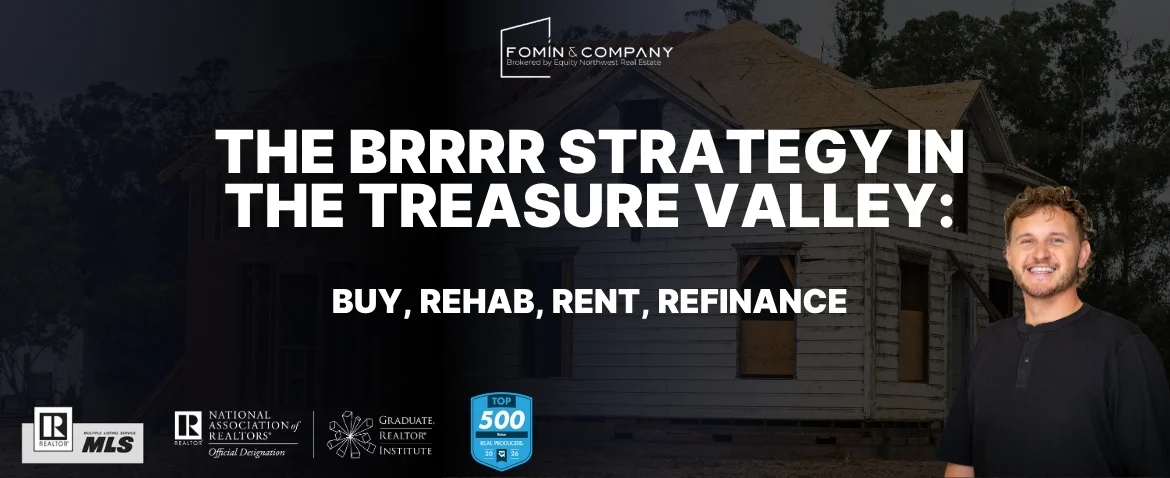
BRRRR Strategy in the Treasure Valley: Buy, Rehab, Rent, Refinance, Repeat
The BRRRR strategy recycles investor capital — here is how it works in the Treasure Valley in 2026 and where it still pencils.
Does the BRRRR strategy work in the Treasure Valley in 2026?
Yes, in specific conditions. Specifically, BRRRR — Buy, Rehab, Rent, Refinance, Repeat — works when you can purchase a property at a meaningful discount to its after-repair value (ARV), complete a value-add rehab cost-effectively, and execute a cash-out refinance that returns most or all of your initial capital. In particular, in the Treasure Valley in 2026, BRRRR works best on distressed or cosmetically dated properties in established neighborhoods where the ARV is supported by strong comparable sales. However, it does not work on listed properties priced at or near market — the discount required to make BRRRR viable is rarely available on MLS listings.
Dennis Fomin — Founder, Fomin & Company | Active Treasure Valley Investor. BRRRR is a capital efficiency strategy, not a renovation strategy. Instead, the focus is on buying at the right discount and executing a disciplined rehab — not on maximizing renovation quality.
The BRRRR Mechanics — Step by Step
Buy at a meaningful discount to ARV
First, the entry point determines whether BRRRR works. Typical BRRRR target: purchase at 65-75% of ARV. For example, on a property with a $450K ARV: target purchase price of $292,500-$337,500. However, this discount is not available on MLS listings in most Treasure Valley submarkets — it requires off-market deals, foreclosures, probate sales, or motivated sellers.Rehab cost-effectively
BRRRR rehab is not a luxury renovation — it is a precision value-add. Fresh paint, updated flooring, kitchen hardware and fixture refresh, HVAC service, and any functional issues that affect habitability or appraisal. Target rehab budget: $25,000-$60,000 for a cosmetic and functional update. In contrast, over-renovating a BRRRR erases the margin.Rent at market rate
After rehab, lease the property to a qualified tenant at market rent. A rented property refinances more easily than a vacant one — the rental income is documented and used in the lender’s DSCR (debt service coverage ratio) analysis.Refinance via cash-out refi
Then, after the property is rented, execute a cash-out refinance based on the post-rehab appraised value. However, most conventional lenders require roughly 6-12 months of seasoning after purchase before a cash-out refi (a ‘delayed financing’ exception can apply to all-cash purchases). In contrast, DSCR lenders may allow sooner. Refinance target: pull out 75-80% of the appraised value.Repeat with recycled capital
Finally, the cash-out proceeds fund the next BRRRR purchase. As a result, successful BRRRR cycles return 80-100% of the initial capital investment — leaving you with a rented property, a new mortgage, and your capital available for the next deal.BRRRR Math — Full Example
Capital recycled
$337,500 refi proceeds minus $345,000 total cost = negative $7,500 net capital remaining in the deal after refi. In other words, this is essentially a full capital recycle on a well-executed BRRRR.New DSCR position
Rented at $2,200/month. New loan balance $337,500 at 7.5% (investor refi rate) = $2,360/month P&I + T&I = $2,755/month total. Monthly negative cash flow: approximately $555/month. Capital remaining in deal: ~$7,500. Therefore, cash-on-cash return is immaterial — the return is from appreciation and equity paydown on a nearly fully recycled capital position.Where BRRRR fails
Overpaying for the entry point, over-renovating for the submarket, underestimating rehab cost, or being unable to find qualified tenants post-rehab. Indeed, any of these erodes the margin that makes BRRRR viable.Where to Find BRRRR Deals in the Treasure Valley
Off-market direct seller outreach
For example, send letters to owners of distressed or dated properties in target neighborhoods. This also requires volume — a 1-2% response rate is typical. Time-intensive but produces the deepest discounts.Probate and estate sales
Properties in probate often sell below market because the estate needs liquidity and the heirs are not primary-residence buyers with emotional attachment to the price. In addition, probate sales in Ada County are searchable through the Ada County court system.Foreclosures and REO
Bank-owned properties occasionally sell at meaningful discounts. However, availability has been limited in the Treasure Valley in recent years. Monitor but do not rely on this channel.Days-on-market reduction plays
Properties that have been listed 60+ days with price reductions often have motivated sellers. Not as deep a discount as off-market, but more accessible. Above all, the key is evaluating the reason for extended market time.Frequently Asked Questions
Looking for BRRRR Opportunities in the Treasure Valley?
Dennis Fomin — Founder, Fomin & Company. Associate Broker, GRI, RSPS. Active Treasure Valley investor. Free 2026 This Is Boise Area Guide.
- —Off-market deal sourcing in distressed and cosmetically dated property segments
- —Rehab cost estimation and ARV analysis before you make an offer
- —Dennis has executed the BRRRR strategy locally — the deal analysis is firsthand
Serving Boise, Meridian, Eagle, Nampa, Caldwell & the Treasure Valley.
Summary
BRRRR is the most capital-efficient investment strategy available in the Treasure Valley — but it is the most execution-dependent. First, the entry point must be correct. Second, the rehab must be disciplined. Third, the tenant must be qualified. Finally, the refinance must appraise at or above target ARV. When all four go right, you hold a rented property with most of your capital returned. However, when one goes wrong, the margin that makes BRRRR viable disappears.
BRRRR is not about renovating homes. Instead, it is about buying at the right price, improving precisely, and recycling capital. The renovation is a means to the appraisal — not the goal.
Dennis Fomin
Founder, Fomin & Company · Associate Broker, GRI, RSPS · Equity Northwest Real Estate208-371-9099 · dennis@dennisfomin.com · Meet Dennis →
903 N Main Street, Meridian, ID 83642
📘 Free Guide: 2026 This Is Boise Life in Idaho Area Guide